
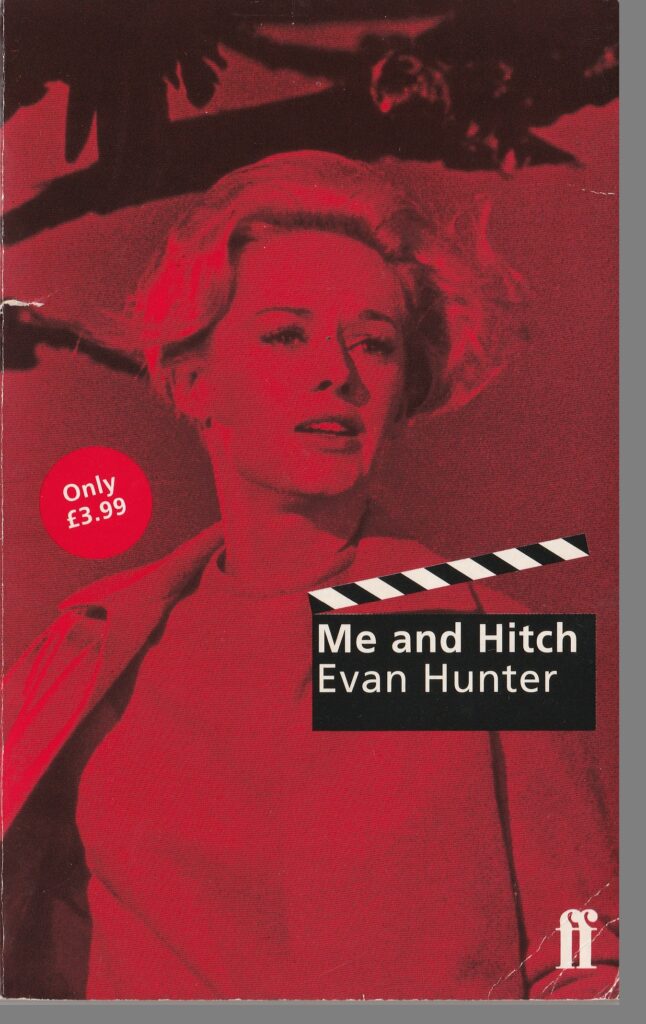
Evan Hunter ends his short 1997 memoir Me and Hitch with praise for the famed director Alfred Hitchcok. Nearly two decades after Hitchcock’s death, Hunter writes:
Every time I publish a new novel, I wonder if it is something Hitch might care to film, something I myself might adapt for him.
Screenplay by Evan Hunter, based on his novel.
Directed by Alfred Hitchcock.
Ah, we can all dream. But Hunter had history with Hitchcock.
An element of revenge
In 1963, Hunter wrote the screenplay for Hitchcock’s movie The Birds, adapting a short story by Daphne du Maurier. And, over the next year, he worked closely with the director on the screenplay for Marnie, based on a novel by Winston Graham.
 So, yeah, on some level, Hunter might dream of working again with Hitchcock.
Me and Hitch, however, isn’t the recollection of a great collaboration with the quirky, strong-willed, maverick director.
Rather, it’s about how difficult it was for Hunter to deal with Hitchcock on The Birds and then how his months of drafting the Marnie screenplay went up in smoke — albeit well-paid — when the director unceremoniously replaced him by having his assistant call Hunter’s agent with the bad news.
There’s a strong element of revenge in Me and Hitch.
And maybe — come to think of it — this is the Evan Hunter book that Hitchcock could have turned into a suspenseful thriller.
(Will the poor woebegotten writer be pushed by his overbearing director-boss past the brink to murder? Or will the sadistic director continue to toy and torment his writer to see if he can get him to crack?)
Making a point
Writers have an unfair advantage over non-writers. Long after events take place, a writer can tell a story about those events and use that story to make a point — a personal point
That’s what Hunter does in Me and Hitch.
His little book — roughly 13,000 words, together with movie stills and storyboards, spread out over 91 pages — is about getting even.
It’s about telling how wrong-headed Hitchcock was in his filming of The Birds. And it’s about how monomaniacal the director was in producing the Marnie film so that he could film a rape at the center of the tale.
There are any number of stories of scriptwriters who have worked well with directors to produce a script that results in a wonderful movie. And there are also many about scriptwriters who feel that their work has been destroyed, sliced and diced, dullified, disemboweled and otherwise screwed up by directors.
Me and Hitch is one of the second sort.
“Appalled”
For instance, Hunter describes the final scene he wrote for The Birds, and, truth be told, it sounds compelling.
Hitchcock, however, didn’t think so. He thought the idea that he and another writer had come up with was the right way to go — as Hunter found out when he finally saw the film.
When I saw the movie for the first time at the Museum of Modern Art’s invitational screening a year later — and realized that Hitch had sacrificed my ending in favor of what he called “the most difficult shot” he’d ever done, a composite of birds requiring thirty-two separate exposures against a matte painting — I was appalled.
The very hip and sophisticated black-tie audience was, to say the very least, somewhat glacially polite in its reception. A stunned silence greeted the final complicated mosaic of what appeared to be 3,407 pieces of bird film.
Later, when I saw the movie in a commercial theater, people actually turned to each other and mumbled, “Is it over? Is that it? Huh?”
“No joy”
As for Marnie, Hunter reports that the reason Hitchcock obtained rights to Graham’s novel was so that he could film the rape of a newly married bride by her new husband.
Time and again, Hunter argued with the director, contending that the man in the couple wasn’t the sort who would force sex on anyone. Hitchcock wasn’t dissuaded.
On the first day of May, Peggy Robertson called my agent to say that I was being replaced on the picture by another writer.
I felt no joy when Marnie opened to dreadful reviews.
Hunter, here, isn’t being honest.
Like any writer who believes in his own work, Hunter was glad — Me and Hitch is proof of this — that both movies seemed to fail. At least, in his opinion.
Reviews of both movies at first were mixed, and Hunter was safe enough panning the films in 1997 when Me and Hitch was published. Since then, though, both have become much more admired.
As for Me and Hitch, it remains, for all its revenge-seeking, a useful reference for anyone writing about or researching Hitchcock and his operating methods.
And I do wonder what the director might have made of Hunter’s story.
Patrick T. Reardon
10.27.26
Written by : Patrick T. Reardon

For more than three decades Patrick T. Reardon was an urban affairs writer, a feature writer, a columnist, and an editor for the Chicago Tribune. In 2000 he was one of a team of 50 staff members who won a Pulitzer Prize for explanatory reporting. Now a freelance writer and poet, he has contributed chapters to several books and is the author of Faith Stripped to Its Essence. His website is https://patricktreardon.com/.