
There is much of the Bible in Herman Melville’s 1851 masterpiece Moby-Dick, and much else besides. As Robert Alter lays out in Pen of Iron: American Prose and the King James Bible, Melville was attempting to create a new type of novel, one rooted in a variety of voices, traditions and sensibilities, a polyphony.
In much of Moby-Dick Melville manifestly seeks to create an aura of epic prestige for his seafaring plebian characters. His decisive models were Shakespeare and Milton…but he also had an intimate familiarity with Job, the Psalms, the Prophets, and the rest of biblical poetry to the extent of unconsciously internalizing some of the basic patterns of expressions of the ancient Hebrew poets; and these, too, became a stylistic resource for him.
Melville’s ambition, Alter writes, was to turn the language of the novel into prose-poetry, and it was “a distinctly American project,” given that there would be nothing like it in British fiction until the early twentieth century.
The “bold polyphony of Melville’s prose” and its “purposely poetic character” are rooted in the author’s desire to draw deeply on his myriad influences, and a key influence was the 1611 English translation of the Bible, known as the King James Version.
Melville wasn’t alone in using as a model and touchstone the great seventeenth century biblical translation that did much to shape the development of the English language. As Pen of Iron details, the King James — particularly the Hebrew Bible portion of it, called the Old Testament — has “worked into the texture of the writing” of William Faulkner and Saul Bellow as well as for Ernest Hemingway, Marilynne Robinson and Cormac McCarthy.
“That old tongue”
Certainly, there have been American writers such as Mark Twain and Henry James with little or no interest in the King James Bible.
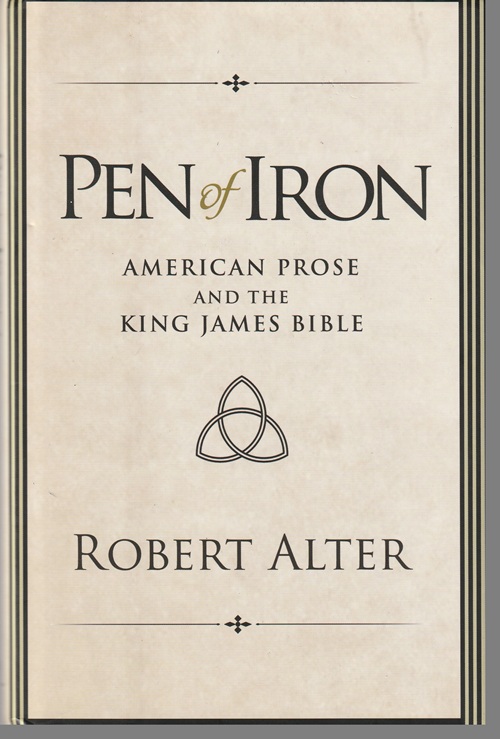 Nonetheless, since the nineteenth century, many American novelists have found the sound and feel of the translation of great use in constructing their own works, “even when the fervid faith in Scripture as revelation had begun to fade.” The fact is, Alter writers, “the language of the Bible remains an ineluctable framework for verbal culture in this country.”
Indeed, as Alter shows, one of the nation’s greatest writers, Abraham Lincoln, used the translation’s rhythms and idioms in achieving his own eloquence, such as in the Gettysburg Address.
The sternly grand language of the King James Bible, as Melville had already demonstrated more than a decade earlier and as Faulkner and others would demonstrate in different ways later, was a way of giving American English a reach and resonance it would otherwise not have had.
Alter quotes Edmund Wilson’s thoughts on the impact of the 1611 translation on the American culture: “Here it is, that old tongue, with its clang and its flavor, sometimes rank, sometimes sweet, sometimes bitter; here it is in its concise solid stamp.” And Alter adds:
Wilson emphasizes the resonant sound and the distinctive feel of the language of the Bible, but he intimates something else as well: that this language articulates a set of values, or perhaps one should say, a set of demands, and a way of imagining man, God, and history, with which we must wrestle, and which we perhaps never quite succeed in fitting to the shape of our own world.
American writers, Alter notes, “continued to perceive in the language of the Bible certain qualities of powerful eloquence, paradoxically coupled with a homespun simplicity…that they wanted to draw on as resources in their own writing.” At the same time, they were utilizing these biblical elements of style in arguing against the Bible’s vision of reality and against the vision of reality of the generations of biblical interpreters.
The Bible, Milton and Shakespeare
Consider, for instance, how Melville’s Ahab echoes many figures of literary heritage, including biblical forebears:
He resembles King Ahab not only as evil monarch but in his heroic defiance: King Ahab at the end, bleeding to death, asks to be propped up in his chariot so that he can continue to do battle, just as Melville’s Ahab at the end, blinded, his boat splintered, persists in the fierce struggle against his terrible foe…
Ahab is also Job, bitterly arguing against what he sees as the skewed moral order of creation, and he is even the blighted generation of Hebrew people wandering forty years in the wilderness (“forty years of continual whaling!…) At the same time, Ahab is also Milton’s Satan and both Macbeth and Lear.
What needs to be kept in mind is that Melville summons up for his own novelistic purposes not only the lineaments of these sundry figures but elements of the poetic language in which they are etched in the texts where they originally appear.
In other words, Melville isn’t only referring to the stories of these figures but also employing in his own way the language — the style, diction, syntax — used to tell those stories.
Quoting and refuting the voice of God in the Whirlwind
In an eloquent scene in which the sailors on three rowboats await the resurfacing of a whale already hooked with harpoons, the narrator quotes five verses from the speech of the Whirlwind — God’s response — to an argumentative, accusatory Job. Alter asks: Why?
He is, to begin with, attracted by the sheer power of the biblical poem, evoking so wonderfully the great Leviathan’s impregnability in the face of all the weapons puny man can muster…
The strong poetry of the speech from the Whirlwind is quoted not merely to be refuted but also to set up a resonance that at the end of the novel will, in Melville’s orchestration of voices, find an answering poetry in his description of the devastating power of the whale.
“Recurrent biblical terms”
In Pen of Iron, Alter looks deeply at three works: Melville’s Moby-Dick, Faulkner’s 1936 novel Absalom, Absalom! and Saul Bellow’s 1956 Seize the Day.
Faulkner reported that he read the King James Version front to back every ten or twelve years, but Absalom, Absalom! doesn’t sound at all biblical in terms of cadence and rhythm. Rather, as Alter notes, he used the Bible for the themes of his story:
The recurrent biblical terms in Absalom, Absalom!, which I shall list either as single items or, where relevant, as clusters of overlapping terms, are: birthright, curse, land or earth, name and lineage, get (as a noun, an archaic term for “offspring” generally restricted in modern usage to animal breeding, which is in part why Faulkner likes to use it for humans, though the biblical “begat” also influences him), sons or seed, birthplace, inheritance, house, flesh and blood (used as both the idiomatic hendiadys and as isolated items), bones (often in conjunction with flesh), dust and clay (both of these in the biblical sense of images of man’s mortal and finite condition).
Faulkner’s focus on these themes, writes Alter, shows “how the writing of this novel is pervasively biblical even as a conspicuously unbiblical syntax and vocabulary are constantly flaunted.”
In this odd way, Absalom, Absalom! is a novel that can be seen as a dense condensation of the entire Hebrew Bible.
“A trapped man”
What distinguishes Seize the Day from novels being written by mid-century British writers is Bellow’s use of the literary (and biblical) technique of parataxis — the offering of a series of short, simple sentences without commentary.
While Alter looks in depth at Bellow’s use of this approach, he also discusses its employment by Hemingway in The Sun Also Rises, Robinson in Gilead and McCarthy in The Road.
Like Walt Whitman (and the Hebrew Bible), Bellow offers at many points in Seize the Day urban catalogues that are “the embodiment of the idea of abundance, of the rich multiplicity of things in the world.” There is a richness and a boundlessness that is the opposite of the constraints and limitations that his central character, “a trapped man,” Tommy Wilhelm, experiences.
This paratactic style communicates Bellow’s story of Tommy Wilhelm, in a way, without words. Bellow’s catalogues don’t tell the reader how they related to the character, but, as sort of a subtext to reading, the reader comes to feel the contrast between Tommy and the vibrant New York in which he lives.
New books of the Bible?
Style is the great agent of transformation in the constructed worlds of novels. Melville’s Shakespearian-Miltonic-biblical style elevates the motley crew and crazed captain of a nineteenth-century commercial whaler into the indelible actors of a cosmic drama.
Faulkner’s serpentine prose, with its recondite diction and its biblical lexical keys, transmutes a Southern family’s catastrophe into an archetypal story of overweening ambition, primal sin, and the unending obsessional memory of historical trauma.
Each writer in his own way used allusions to the King James Bible to raise the stakes of the stories they were telling. In fact, it would be easy enough to envision Moby-Dick and Absalom, Absalom! as two newly added books of the Hebrew Bible.
Gravitas, wonder and expansiveness
Think, too, of Seize the Day joining the biblical canon, perhaps next to the Book of Job or Ecclesiastes. Alter writes:
Bellow’s writing is pitched more toward making the palpability of the here and now imaginatively available. This is an aim it shares with the Hebrew Bible, though of course Bellow’s descriptive impulse is not part of the literary project of the biblical writers.
What he does have in common with them is a desire to present the narrative data in ways that allow them to speak for themselves, without a sense of elaborative literary meditation, without an obtrusive feeling of language calling attention to itself.
Bellow is not seeking to write another book of the Bible. Yet, Alter notes, it’s clear that he had “internalized something of [Bible’s] dignified, even stark, simplicity of diction.”
So, in their own ways, have Melville, Faulkner, Hemingway, Robinson, McCarthy, Lincoln and many other American writers.
The King James Bible — and the Bible in whatever form — represents an entire universe of stories, ideas, conundrums, traumas, hopes and beliefs that able and sensitive writers can tap into to add gravitas, wonder and expansiveness to their work.
“In the beginning…”
Patrick T. Reardon
10.22.26
For another perspective on this book, take a look at the review I wrote in 2017 when I read Pen of Iron the first time.
Written by : Patrick T. Reardon

For more than three decades Patrick T. Reardon was an urban affairs writer, a feature writer, a columnist, and an editor for the Chicago Tribune. In 2000 he was one of a team of 50 staff members who won a Pulitzer Prize for explanatory reporting. Now a freelance writer and poet, he has contributed chapters to several books and is the author of Faith Stripped to Its Essence. His website is https://patricktreardon.com/.