
In 1170, King Henry II of England refused to give a kiss on the mouth to his former friend Thomas Becket, the Archbishop of Canterbury, then living in exile in France. Becket returned home anyway, and, within days, he was gruesomely assassinated in the cathedral by four of Henry’s knights.
Becket had wanted Henry’s kiss as the customary conclusion of a peace negotiation “and strong evidence of their fides (faithful character), of their future goodwill towards each other,” writes Katie Barclay in The Kiss. Henry’s kiss would have guaranteed Becket’s future safety. The assassination made it clear why Henry said no.
What Becket had sought was called the kiss of peace, and, during the Middle Ages, it was the usual way that disputes were settled among diplomats, officials and everyday people. Barclay notes that it likely grew out of the kisses that Christians exchanged during religious services. “Greet one another with a holy kiss,” the apostle Paul wrote in his letter to the Romans.
Many Christian saints, such as Francis of Assisi, amazed their contemporaries by their willingness to kiss lepers who suffered from what is now known as a bacterial condition that often led to the loss of nose, lips, hands and feet. Radegund, a Thuringian princess and nun, “kissed even their faces, loving them with her whole soul,” according to her biographer.
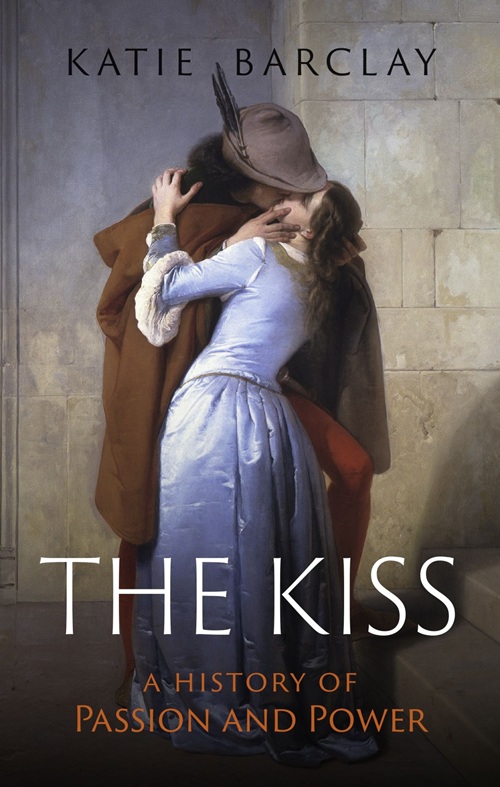 Giving a kiss to a leper is a far cry from what comes to mind from the image on the cover of Barclay’s book, published by Reaktion Books in the U.K. and distributed in the U.S. by the University of Chicago Press.
It is the widely reproduced 1859 painting, The Kiss, by the Italian Francesco Hayez in which a couple, “wearing stage-medieval garb,” kiss. The male bends over his lover, holding her mouth. She leans backwards, holding his shoulder for support, as they touch lips.
The Silly Kisses, the Rude and Naughty Ones
Barclay, a history professor at Macquarie University in Sydney, notes that this is the sort of kiss that people today think about when the word is used, “an expression of sexual desire, passionate connection and intimacy.”
The Kiss, a survey of Western civilization over the past thousand years, has its fair share of such romantic kisses, but, as the stories above of Henry II and of saints kissing lepers indicate, Barclay is interested in a lot more:
It turns out that I am not very romantic. In researching the kiss, I was more drawn to the silly kisses, the rude and naughty ones, than the solemn. I found kisses that were bad ideas, dangerous kisses, and others that were funny. Kisses were had between lovers, but also parents and children, friends, enemies, monarchs and subjects, and citizens in fraternal embrace.
Kisses organized not only our private lives, but our political worlds. They expressed the many forms that love might take in a wide range of relationships, but other emotions too. Kisses might have produced shame, jealousy, anger; they might have been the product of grief and loss, as well as longing.
The politics of kissing
Kisses, she writes, also have their own politics, noting, “A kiss that was acceptable in one time and place might be rude or even criminal in another.”
Consider the Hayez painting again. Barclay notes that, as the woman leans back, it’s possible that she’s being forced in that direction. Asking the question is all but unavoidable today when the #metoo movement has raised awareness of the rights of women to choose to give or deny consent to “romantic” or sexual overtures.
Consider the similarly famous image of a Navy sailor kissing a nurse in her hospital whites in Times Square during the celebration of V-J Day (the end of the war in the Pacific) on August 14, 1945. One version, a photograph by Victor Jorgensen, appeared in the New York Times the next day, while the much better known one by Albert Eisenstaedt was published in Life magazine a week later.
The kiss seemed to be part of a romantic embrace of elation, yet Barclay notes that a closer look at the woman shows that idea to be false.
Her right arm is bent and is pressed awkwardly between their bodies; her left hand is clenched in a fist. Another image shows this same fist pushing against his chest…The V-J kiss was an act of force, an impression affirmed by other images of the evening’s events. The same sailor was captured kissing a second woman in a picture that shows her arms bent and hands pushing off against his chest.
Kisses, kisses and more kisses
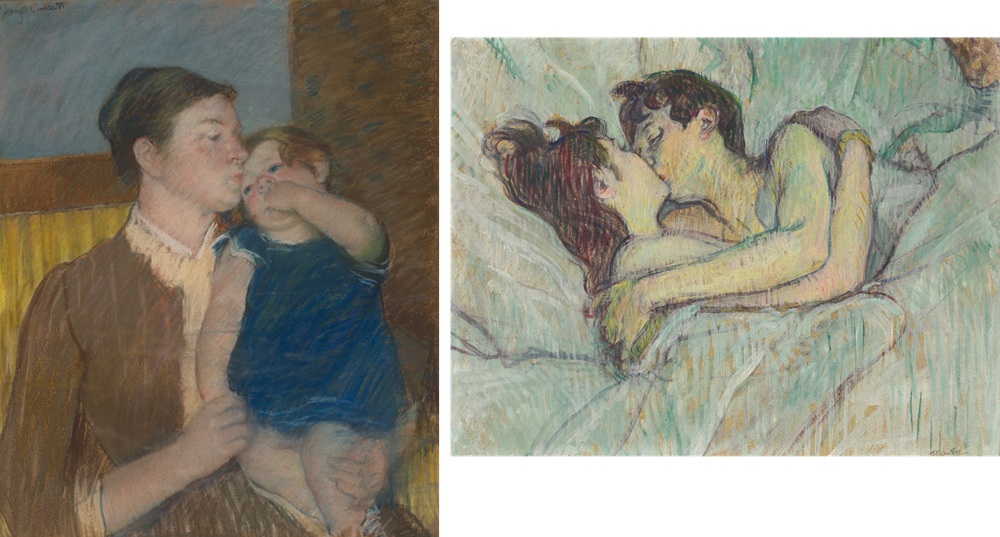
A center color section of twenty images of kissing suggests the wide range of Barclay’s book. There is, for instance, an 1888 painting by Mary Cassatt of a mother kissing her near-slumbering child, Mother’s Goodnight Kiss, as well as Honoré Daumier’s The Kiss, created about forty years earlier, of a working-class father kissing his infant son.
The father’s bent knees and curved body, and the infant’s naked, waggling feet, are suggestive of movement—a kiss that each is excited for, perhaps capturing a return home by a working man.
An adulterous kiss of a young woman and her lover is the subject of a hand-colored 1830 aquatint by Joseph Lisle, but, instead of thundering scandal, the image is a comic send-up of the woman’s much older husband who is spying on them from behind a screen. It’s titled The Observer.
“Arse kissing”
A seven-hundred-year-old doodle in the margin of a French manuscript shows a dog-monster hybrid kissing a monkey’s behind. Many outsider groups challenging the status quo were accused of such “arse kissing,” Barclay, an Australian, writes.
An arse kiss was an inversion of a holy kiss, a corrupted ritual used by heretics and witches to shame and humiliate others…Rather than bringing individuals closer to God, however, the arse kiss was a spectacle designed to mark individuals and groups as separate from the Christian community, evidencing a sinful human nature.
Other color images include the once scandalous Henri de Toulouse-Lautrec 1892 painting In Bed: The Kiss, showing two female sex workers tightly embracing, faces pressed closely together.
The warm tones of the paint underscores the work’s sensuous nature…The couple appear lost to the physical sensation—to the pleasure—of each other’s touch. The viewer encroaches on a private moment of female desire.
“Still a kiss”
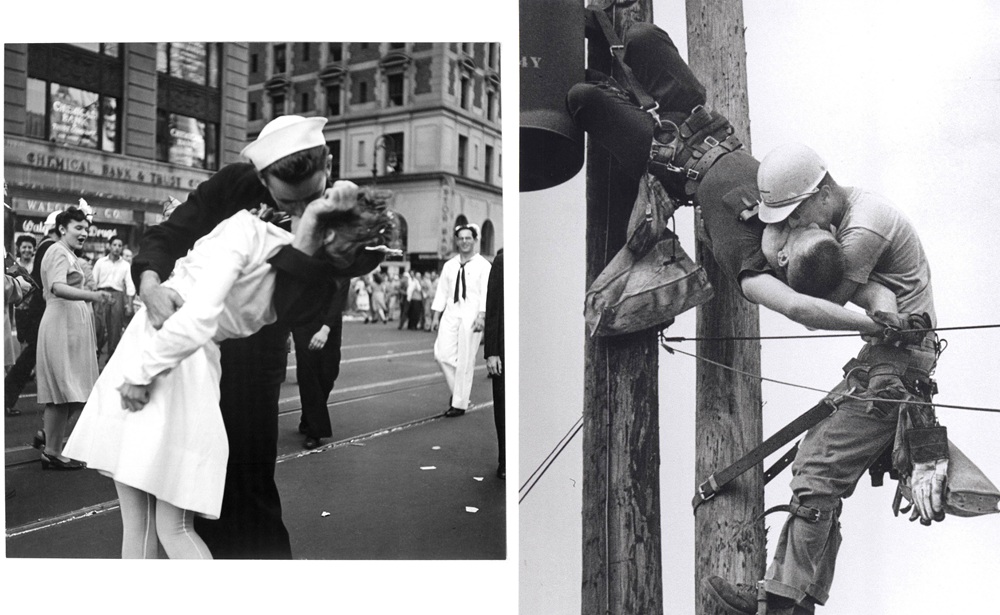
Many of the fourteen black and white images in the book are also striking.
They include Victor Jorgensen’s V-J photo in Times Square; the 1967 Rocco Morabito photograph The Kiss of Life, showing a male linesman giving mouth-to-mouth resuscitation to an electrocuted colleague; and a plaster cast of Auguste Rodin’s 1882 sculpture The Kiss, showing two seated nude lovers, bending toward each other and about to kiss.
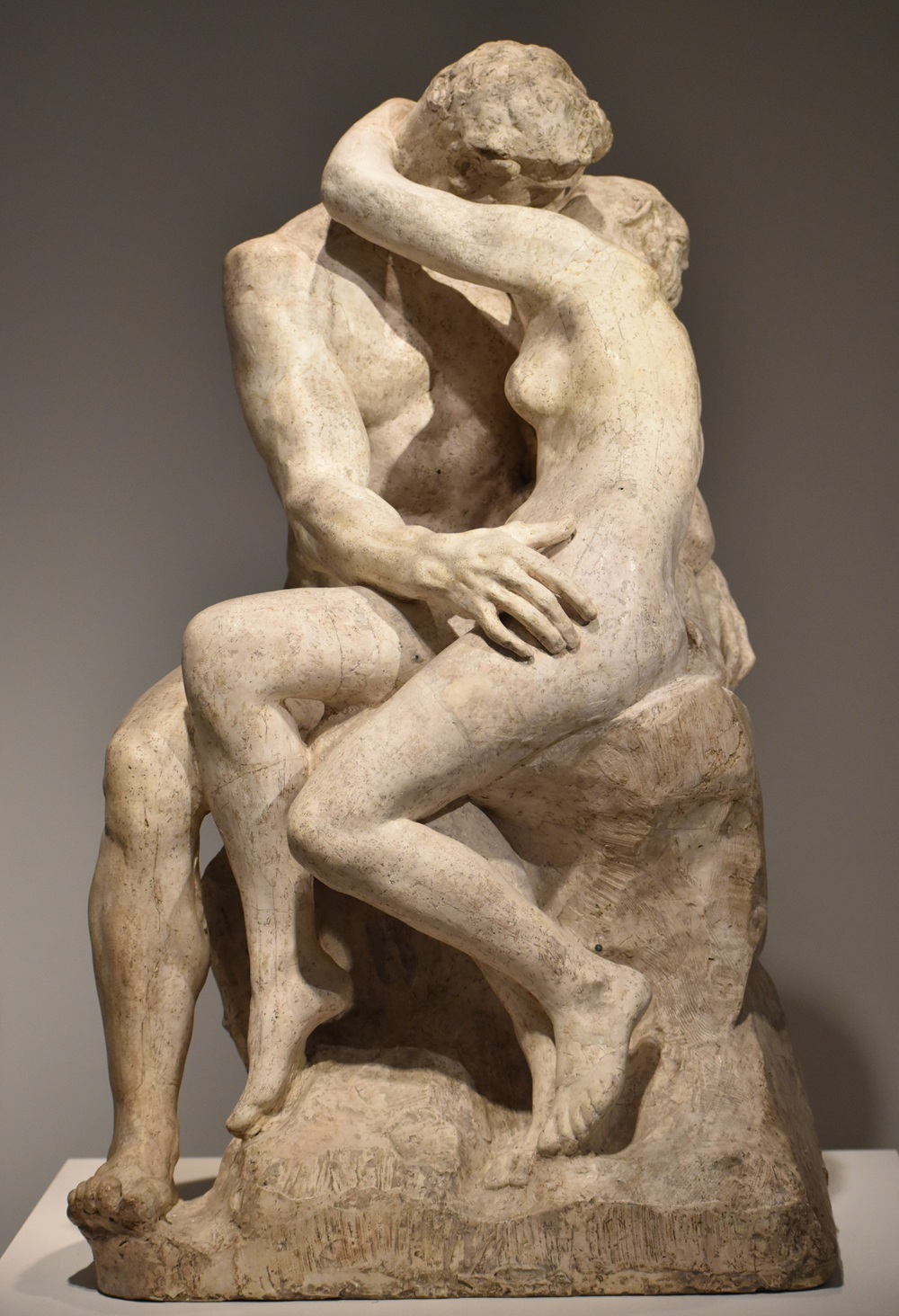
Today, with images and replicas of the Rodin work everywhere, it’s one of the best-known artworks worldwide. Yet, Barclay writes, when The Kiss came to Chicago for the 1893 World’s Fair, “it was considered too lewd for public view” and was locked away, “available only by individual appointment.”
Barclay is an academic who has written extensively on the cultural history of emotions, including loneliness, happiness and love. While The Kiss is a deeply researched book, Barclay writes with wonder, curiosity and clarity about the many ways Western culture has employed and enjoyed the gesture.
In the 1942 movie Casablanca, Dooley Wilson (Sam) sings “As Time Goes By,” which begins: “You must remember this/A kiss is still a kiss.” It’s a song covered by myriad singers, most recently Josh Groban on his 2026 album Cinematic.
It’s a song that the reader of The Kiss is likely to hear a bit differently with Barclay’s richer understanding of all that kissing can mean and has meant. A kiss is, well, a lot of things.
Patrick T. Reardon
10.5.26
This review originally appeared at Third Coast Review on 10.12.26
Written by : Patrick T. Reardon

For more than three decades Patrick T. Reardon was an urban affairs writer, a feature writer, a columnist, and an editor for the Chicago Tribune. In 2000 he was one of a team of 50 staff members who won a Pulitzer Prize for explanatory reporting. Now a freelance writer and poet, he has contributed chapters to several books and is the author of Faith Stripped to Its Essence. His website is https://patricktreardon.com/.