
I’m pretty sure I’ve never seen a review open with a discussion of the dedication at the start of a book. But that’s what I’m going to do here because the dedication for Bonnie Jo Campbell’s new novel The Spirits is significant.
The dedication for The Spirits—the story of a hardscrabble rural Michigan family haunted by their six foot-seven inch “human storm” of a patriarch, killed during a lightning storm—has to do with trees. It’s beautifully written so let me quote it:
To the forests of Michigan, to the white pines, the wise oaks and their acorns, to the shagbark hickories, the snakeskin sycamores, the sugar maples and beeches, the black cherries and black walnuts, the American basswoods, the water-loving willows and gums, the elegant birches, the shade-giving catalpas, the saintly redbuds, and the sweet fruiting pawpaws nestled at the edge.
Trees play significant roles in The Spirits. Many, for instance, were the victims of Daddy who “had made it part of his life’s work to cut down all the trees” on their property next to a cemetery.
Sister, named for Daddy’s sister who was a Catholic nun, Sister Eugenia, “had watched, horrified and helpless, as one giant after another fell in order to become firewood Daddy could burn or sell to put food on their table.”
Dead for nine years
Daddy—Henry Whitby—has been dead for nine years.
If that sentence seems vaguely familiar, it’s because it’s a distant echo of the start of Charles Dickens’s classic novella A Christmas Carol: “Marley was dead: to begin with.” The Spirits is being marketed as a contemporary version of the Scrooge tale, and that’s accurate, sort of.
Like the Dickens fable, Campbell’s novel takes place on a single Christmas Eve night, but it’s much more nuanced. Dickens wrote a contemporary Christian parable like a play with three main acts.
In its complex way, Campbell’s novel wrestles with family dysfunction, the natural world, the interconnection of the forest and the phenomenon of lightning, grapples with beauty, guilt, abuse, growth, pain, murder, sadness, violence, love, grief, bitterness and forgiveness.
Any number of ghosts
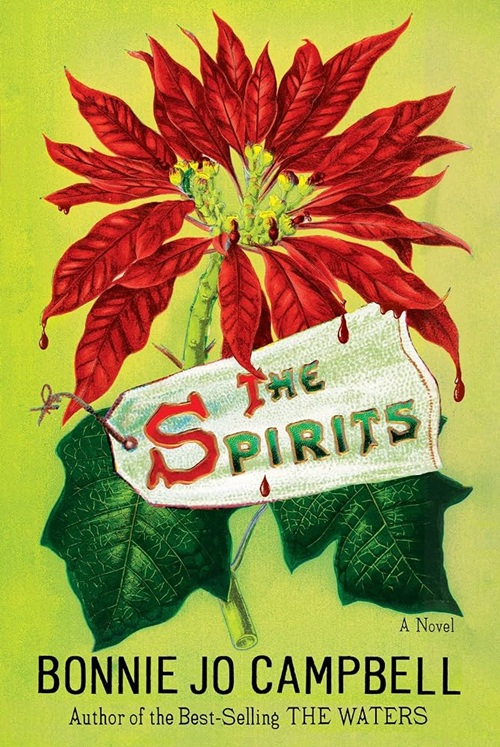 As the novel opens, Sister, now 23 and six-foot-tall, has been working at the local greenhouse since shortly after Daddy’s death and pays the taxes on the family home and other important bills. Her siblings are Doug, 21, about to graduate from the University of Chicago; Beth, a young 14, named for Daddy’s other sister Elizabeth; and Trevor, strikingly tall for an 11-year-old. Their mother Linda has been able to keep the family together and afloat with the help of the Covenant Church of Paw Paw.
Instead of Scrooge’s three specters, past, present and future, The Spirits is populated by any number of ghosts. The spirits of all those ancient trees Daddy chopped down, for instance. The ghost of Daddy’s dog Molly. The ghost of the single white pine that Sister had been nurturing and tending since Daddy’s death until Trevor boyishly cut it down so the family would have a pretty Christmas tree.
And, of course, the ghost of Daddy which is the only one that can be seen and only by Sister and, pretty much, only as a smoky presence here and there in the family home built by his father.
There are also, for the family members, the ghosts of their complicated feelings when Daddy was alive and of the even more complex emotions they been experiencing since his death.
Numbness and denial
The Whitbys are a family stuck in thick numbness and denial, but, on this Christmas Eve, into their midst comes Mary, Doug’s girlfriend. In an echo of Tiny Tim, she walks with crutches because of injuries from an accident. And, in her frankness, curiosity and affection, Mary changes the family rhythms.
In fact, it turns out that, from a distance, she has already been having an effect through a book she suggested Doug give to Sister.
For years, Sister had cared only about propagating trees and bushes, but then she read the book that Doug had given her for Christmas last year, The Wood Wide Web, and learned how important the understory is if trees are going to be healthy. The book explained how indigenous plants, shrubs, and trees all work together underground, with the help of fungi. She had learned more about root systems from those three hundred pages than from eight years of experience at the greenhouse.
“Do trees scream?”
During the evening, Sister confronts Trevor about cutting down the white pine she had so lovingly nurtured and explains the impact that cutting down a tree has. “Trees are part of an underground soil network. When you kill a tree, it affects everything around it, all the other trees and plants.”
That’s right, says Mary, chiming in and mentioning The Wood Wide Web (which, by the way, isn’t a real book). She says to Sister, “Don’t you love how they describe the fungus and microbes and roots all working together? Everything is connected! Apparently when you kill a tree, it sends distress calls across the whole forest.”
“Do trees scream when you chop them down?” Beth asked.
“They don’t scream, but they do react. The other trees around them react too.” Mary looked to Sister for confirmation.
All those beautiful trees
Here is where the importance of the book’s dedication comes in. All those beautiful trees that Campbell describes, tightly connected in an underground network, feeling each other’s pain and providing each other support, are a metaphor for all the beautiful Whitbys, as ugly or unfit as each of them may feel.
Indeed, each family member, while suffering from Daddy’s fury, also suffered to see the pain he inflicted on the others. “There had been no escape from their patriarch, who was planted as firmly at the center of their lives as any almighty tree in a forest.” One of the first things Mary was told when she arrived this night with Doug was the comment by sweet Beth: “Anyways, if Daddy’s in heaven, I might not want to go there.”
Like the trees of the forest
As the night goes on, the Whitbys begin to understand that, like the trees in the forest, they don’t stand alone. What Daddy did to each individual impacted the others. What happened to Daddy in the lightning storm impacted them and still does.
A Christmas Carol had the happiest of endings. The mean, bitter Scrooge turned his life around and became a kind of Saint Scrooge.
The Spirits has an ending that is bitter and happy and hopeful. The Scrooge who was Daddy can’t change. But the Scroogeness of each Whitby does not have to remain locked in place. Change is possible and begins to happen.
In the final pages, Sister finds perspective, feeling “tiny among the godlike trees.” Yet, as “godlike” as they may seem, she knows that their strength lies in their links with all the other living things of the forest. And the Whitbys are starting to learn that the same is true for them.
Patrick T. Reardon
10.2.26
This review originally appeared at Third Coast Review on 10.9.26.
Written by : Patrick T. Reardon

For more than three decades Patrick T. Reardon was an urban affairs writer, a feature writer, a columnist, and an editor for the Chicago Tribune. In 2000 he was one of a team of 50 staff members who won a Pulitzer Prize for explanatory reporting. Now a freelance writer and poet, he has contributed chapters to several books and is the author of Faith Stripped to Its Essence. His website is https://patricktreardon.com/.