
For two centuries, Italian painter Annibale Carracci was considered one of the greatest of European painters. Yet, odds are, unless you’re a deep fan of Renaissance art, you’ve never heard of him.
Michelangelo, Picasso, da Vinci, Vermeer, Rembrandt, Caravaggio, Rubens—those are some of the household names of painters for the general public. Carracci, no.
Yet, in 1674, two monuments were erected in the Roman Pantheon to men buried there—one for the painter Raphael who had died more than a century and a half earlier, the other for Carracci, who followed admiringly in the older man’s footsteps. The monuments, writes art historian F.M. Gage, “concretized Annibale’s position beside Raphael at the summit of European painting.”
Indeed, in Annibale Carracci: Art, Wit and Authority—published by the London-based Reaktion Books and distributed by the University of Chicago Press—Gage notes that the original epitaph on Carracci’s monument began: “In Genius, Art, and Fame, he was the next to the famous Raphael, and buried in the same Place.”
Not only that, but, as Gage points out, Carracci (1560-1609) and Caravaggio (1571-1610) “were the two most accomplished and original painters of their generation in Italy, their artistic achievements transformed European art.”
Caravaggio expressed admiration for some of Carracci’s earlier works. Yet, they were very different artists. By the time Caravaggio started making paintings with his signature tenebrism (extreme violent contrasts between light and dark), Carracci had moved away from his earlier interest in sharp visual conflicts.
Annibale’s articulation of ideal beauty in his Roman years nevertheless stood in marked contrast to Caravaggio’s penchant for realism, the representation of forms and figures with all the particularities and flaws of earthly existence. Annibale’s representation of celestial beauty in his Assumption distilled the grace and beauty of Raphael…
“Practically invisible”
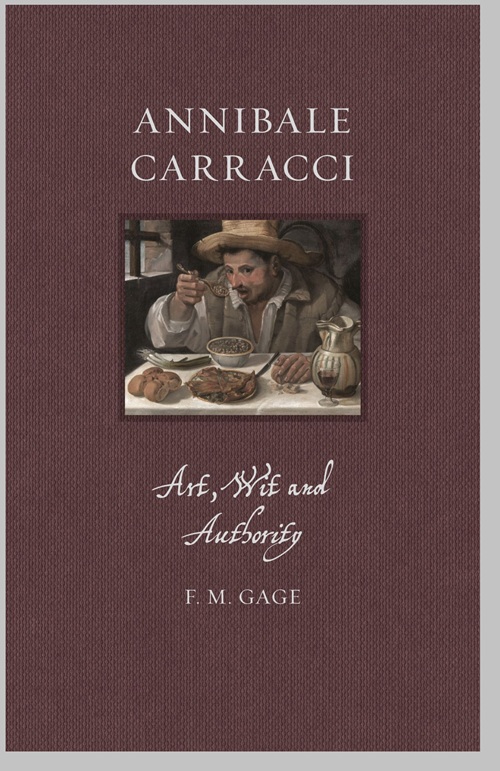 Nonetheless, Carracci—seen in his time as an equal to Raphael and on a level with Caravaggio—“is practically invisible to the broad public today, even in Italy, in spite of the fact that he is author of one of the greatest pictorial monuments in Rome,” writes Gage, an associate professor at SUNY Buffalo State University.
That, however, seems to be a big part of the problem.
Carracci’s great work is the Farnese Gallery which includes the fresco cycle of ceiling paintings known as The Loves of the Gods. This work, completed shortly before his death, was hailed by early seventeenth century critics, such as French painter Nicolas Poussin, as equal to or better than Raphael’s work. Carracci, “having surpassed all the painters of the past,” surpassed himself with the Gallery, said Poussin.
A late eighteenth-century connoisseur said Carracci’s gallery was among Rome’s three greatest paintings, the others being Raphael’s frescos at the Vatican and Michelangelo’s Sistine Chapel.
Locked away
Yet, for nearly a century, this great work of art has been locked away from the public. It’s as if no one but the Pope could see Michelangelo’s Sistine Chapel ceiling and Last Judgement.
In 1936, the Italian government gave, for a period of 99 years, the Farnese Palace to France to use as its embassy. As a result, it has been “long inaccessible to visitors,” writes Gage.
Even today a visitor on a guided tour will be allowed only a few minutes to gaze at the frescoes, scarcely enough time to take them in. Annibale’s works on the whole are often not available in quality reproductions, if at all, though recent photographs of the Farnese Gallery, and particularly those taken following the restoration of the frescoes in 2015, go some distance towards rectifying this situation.
The first modern biography in English
To help remedy that, Gage’s book, the first modern biography of Carracci in English, includes eleven sumptuous color images of the Farnese ceiling and gallery as well as dozens of reproductions of his other works.
Annibale Carracci: Art, Wit and Authority is the latest installment in Reaktion’s ten-year-old Renaissance Lives series, now numbering more than four dozen, all of which are available in the U.S. from the University of Chicago Press.
These books, each of about 250 to 300 pages and filled with lavish, appealingly reproduced images, focus on artists, writers, scientists and other luminaries of the Early Modern world. Recent titles include Michelangelo and the Viewer in His Time by Bernadine Barnes, John Donne: In the Shadow of Religion by Andrew Hadfield, Artemisia Gentileschi and Feminism in Early Modern Europe by Mary D. Garrard and Francisco de Zurbarán and the Fabric of the World by Jeremy Robbins.
Most of these books examine a particular aspect of the work of an artist, writer or leader. Gage’s Carracci book, by contrast, tries to make up for lost time by packing into 260 or so pages his entire life as well as his afterlife, first as a highly admired artist and then as an out-of-fashion, often-ignored figure.
Telling the story of Carracci as a painter is further complicated by the need to recount the life of Carracci the teacher.
“Repairing” art
Together with his younger brother Agostino and their elder cousin Ludovico, they founded the Carracci Academy in their native Bologna. Although Annibale became “the most famous of the three Carracci, largely on account of his work in the Farnese,” notes Gage, the three Carraccis “transformed Italian art in the late sixteenth century.” In founding their academy, the three
pursued artistic perfection through significant stylistic and pedagogical innovations, primarily through uniting northern Italian coloring with central Italian disegno (a term referring to the perception and rendering of form), while training the next generation of painters, many of whom would be similarly celebrated. If Annibale received the principal share of renown, the Carracci laid the foundations for the style that would dominate European art for nearly two hundred years.
This style, aimed at “repairing” art, combined the best aspects of the work of the leading artists of four major schools of Italian painting, “in essence developing a ‘national’ style by a conjunction of the dominant regional manners. As Ludovico himself characterized their project, the Carracci would ‘take the best from all the best.’ ”
Gage doesn’t say so directly, but a modern reader might suspect that this amalgamation of artistic styles, although favored for a long while, may have come across ultimately as bland, especially up next to Caravaggio, for instance, or Rembrandt.
Trying to cover so much ground, Gage has produced a book that is likely to be a richer experience for art experts than for the casual reader. Nonetheless, Annibale Carracci: Art, Wit and Authority is not a bad place to start to learn about the artist—especially since his Farnese Gallery masterpiece is still locked up behind French embassy walls.
Annibale Carracci is available at bookstores and through the University of Chicago Press website.
Patrick T. Reardon
11.11.26
This review originally appeared at Third Coast Review on 11.13.26
Written by : Patrick T. Reardon

For more than three decades Patrick T. Reardon was an urban affairs writer, a feature writer, a columnist, and an editor for the Chicago Tribune. In 2000 he was one of a team of 50 staff members who won a Pulitzer Prize for explanatory reporting. Now a freelance writer and poet, he has contributed chapters to several books and is the author of Faith Stripped to Its Essence. His website is https://patricktreardon.com/.