
When you think of great Chicago art, maybe it’s Georges-Pierre Seurat’s A Sunday on La Grande Jatte at the Art Institute of Chicago that comes to mind. Or maybe the fifty-foot-tall, 160-ton steel sculpture designed by Pablo Picasso outside the Richard J. Daley Center which has become a high-art symbol of the city. Or Anish Kapoor’s Cloud Gate, also called The Bean, in Millennium Park.
But, in terms of worldwide recognition and popularity, Grant Wood’s American Gothic is something more. It’s not just a great work of art. It is also an international art icon, similar in its reach and recognition and replication to Leonard da Vinci’s Mona Lisa and Edvard Munch’s The Scream.
People around the world recognize the two figures in Grant Wood’s 1930 painting—the older, balding man in round, metal-frame glasses, holding a pitchfork and standing with a younger, blond-haired woman—even if they know nothing about the painting itself.
They know these two from a vast array of appropriations which use them, often in a much-edited version, to sell things and comment on events and make jokes. Day in, day out, they see them in advertisements, parodies, political cartoons, corn flake box covers, memes, holiday cards, magazine covers, newspaper illustrations, Broadway plays, television shows, protest placards, family photos and, well, the list is seemingly endless.
The original art and the icon
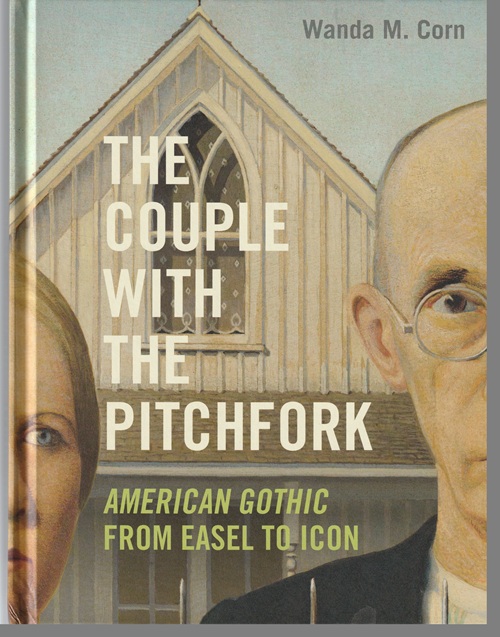 In fact, as Wanda M. Corn argues in The Couple with the Pitchfork: American Gothic from Easel to Icon from Princeton University Press, there are two American Gothics: one, the original work of art; the other, the icon image that permeates world culture.
American Gothic is a precious and unique object; it is a singular, handcrafted thing hanging in the Art Institute of Chicago. Seen in a prestigious, temple-like museum, it radiates, as art theorists have argued, the aura of an original creation.
The icon, on the other hand—“the Couple with the Pitchfork”—is an autonomous image, not a material thing, that has been excerpted from the art object and continually compressed and rephrased to service modern-day wishes and demands.
Like a child with an independent life
An icon, writes Corn, an art historian at Stanford University, is like a child who grows to adulthood, carrying the family name but leading an independent life. An iconic reenvisioning of American Gothic may use a lot or a little of the original. Wood’s painting “has proven to be a compact and formulaic visualization of family and marriage and of work and labor.”
The man and the woman, and their stance and clothing and faces, “can also be used to represent a range of modern-day social types—the repressed, the militant, the mean-spirited, the ideologue, the evangelist, the oppressed, the marginalized, and the activist.”
For instance, in 1971, in a photomontage, Alfred Gescheldt put the head of Shirley Chisholm, a Black integrationist, on top of the woman’s body, and the head of Geroge Wallace, a white segregationist, on the man’s body, and titled the work “Politics Make Strange Bedfellow.”
In 2003, a publicity photograph for the reality television show The Simple Life showed the two stars with a pitchfork, Paris Hilton in the woman’s spot and Nicole Richie in a peek-a-boo bra taking the man’s place.
The Art Institute’s Christmas card for 1989 showed Santa from the back as he studied Wood’s painting. Fourteen years earlier, Corn and her husband Joe had sent out a holiday car showing them dressed like Wood’s couple, each holding a pitchfork to indicate marriage parity.
A joint biography
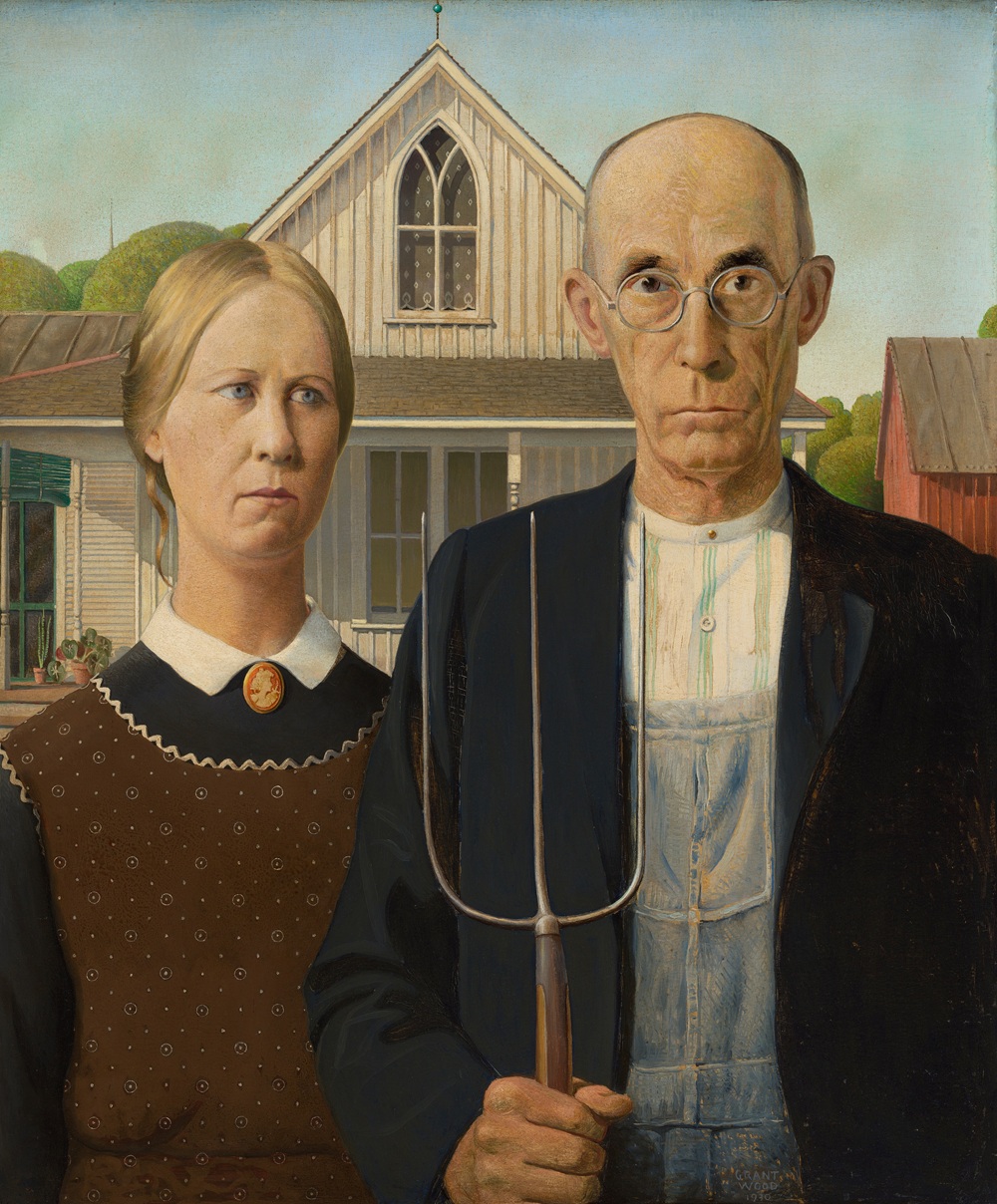
Corn describes The Couple with the Pitchfork as a joint biography of the man and the woman in the icon—not the actual people who posed for Wood’s painting (although their stories are told), but the couple who, in the cultural consciousness, are inextricably linked. Even if one is shown alone, such as the man’s head on a Rambo-like body on a birthday card, the other is present in abstentia.
Even more, Corn’s book is a joint biography of Wood’s painting and of the icon it gave life to. The first half of the book details who Grant Wood was, how he came to paint American Gothic, and what the painting’s immediate and wide success meant for his career. The second half goes deep into how the Couple with the Pitchfork came to life as “a useful idiom,” an image well-enough known that it could be employed to send a message after being visually manipulated and refashioned.
This is familiar ground for Corn who, in 1983-1984, curated Grant Wood: A Regionalist Vision at the Whitney Museum of American Art in New York, the Minneapolis Institute of Arts, the Art Institute of Chicago and the M.H. De Young Memorial Museum in San Francisco.
Corn wrote a book based on the exhibit that included a fourteen-page chapter on the making of American Gothic into a national icon. Her new book notes that, four decades later, the stretch of the Couple with the Pitchfork has become international, now extending to England, Italy, Canada, France, Germany, Scandinavia, New Zealand, Poland, Ukraine, Russia, Mexico, South Africa, Israel, Saudi Arabia, China and Japan.
“An accidental masterpiece”
From the start, East Coast critics were hard on Wood and American Gothic, and the main reason may have been that it was art that was popular and accessible. “That it circulated so immediately and often in the media,” writes Corn, “suggested the easy accessibility of a pop tune, not the complexity of a symphony.”
But, if Wood was buoyed by the popular acclaim accorded his painting, he was irritated by the assumption that every viewer of the work made that the couple was a farmer and his wife.
“In Wood’s mind, the two people in front of the house represented a father and his aging daughter—a spinster—living in small-town America,” writes Corn. Indeed, Wood’s model for the man was his dentist and for the woman, his sister, Nan Wood Graham who regularly told interviewers that her brother painted her to be a prudish daughter who lived with her father.
Wood wanted the picture he painted to poke mild fun at this father and daughter, but he was too subtle. Instead, inadvertently, he tapped into something deep in the culture, the need to see the two figures as a farm couple.
This is one of the best examples in the history of art of how an artist’s intentions in a work can differ from the public’s reception of a painting. The artist paints one thing, his audience sees another. It is what people see in American Gothic that determined its fame, not the artist’s originating idea. It was an accidental masterpiece.
“Their stiffness and sternness”
Art icons, Corn writes, need to be studied more—why and how do they happen, what do they mean. At the end of her book, she speculates on why American Gothic has become such an icon.
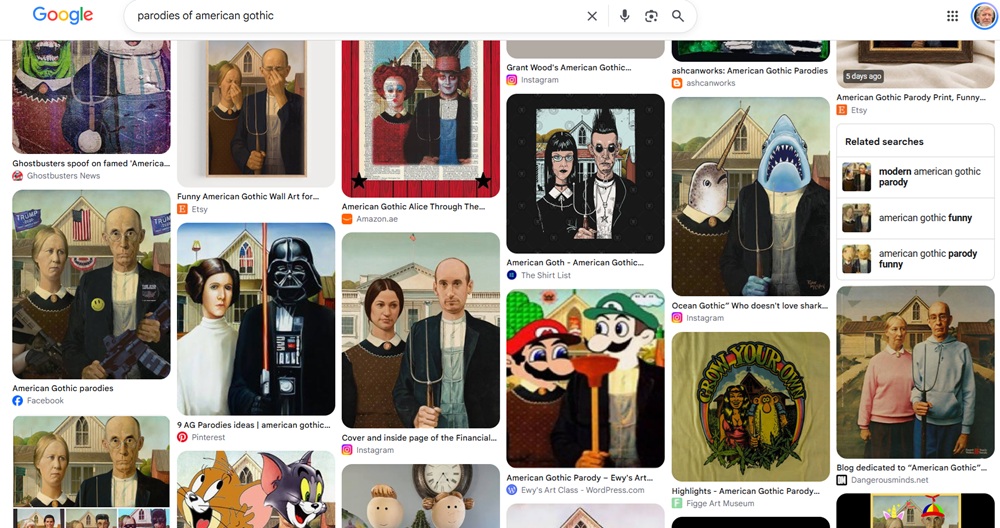
A screengrab of a small number of the seemingly endless parodies to be found online
There is something archetypal about Couple with the Pitchfork, writes Corn. The man and the woman, in the viewer’s eye, represent marriage, a family, in the same way that Whistler’s Mother represents motherhood, and Mona Lisa represents female seduction, and Munch’s Scream represents psychic fear, and Edward Hopper’s Nighthawks represents modern ennui. In addition, Corn writes:
Another reason American Gothic has risen to iconicity, while other famous couple paintings…have not, is that Wood’s formulation is better packaged for the postindustrialized world. It is a democratic and commonplace version of marriage….
I would add one other variable to explain the couple’s charisma: they present a personality type instantly understood by people living in a post-Freudian world. Their stiffness and sternness overstate what modern people understand to be psychological inhibition.
So, they aren’t just a couple. They are also uptight which adds to the zest of playing with their images. “Many appropriators,” Corn writes, “comment upon the couple’s presumed inhibited sexuality by making fun of it; they cast them as super-sexed, in the nude, in suggestive poses, and dancing with abandon.”
The Couple with the Pitchfork is a rich examination of Wood’s work of art and of the icon that had become embedded in the world’s cultural life. It’s also a book that looks beyond art to what makes people people.
After all, what is it in me and you and people around the world that resonates so deeply with an image that sprang from the mind and hand of a little-known Iowa painter nearly a century ago?
Patrick T. Reardon
10.23.26
This review originally appeared at Third Coast Review on 10.27.26.
Written by : Patrick T. Reardon

For more than three decades Patrick T. Reardon was an urban affairs writer, a feature writer, a columnist, and an editor for the Chicago Tribune. In 2000 he was one of a team of 50 staff members who won a Pulitzer Prize for explanatory reporting. Now a freelance writer and poet, he has contributed chapters to several books and is the author of Faith Stripped to Its Essence. His website is https://patricktreardon.com/.