
Near the end of Chicago’s Art Deco Skyscrapers, Joseph Gustaitis rhapsodizes about the huge, imposing Merchandise Mart. Actually, Gustaitis does a lot of rhapsodizing in telling the story of the city’s twenty Art Deco tall-tower jewels, an exquisite collection of art and commerce.
Regarding the Merchandise Mart, he has this to say:
With its zigzags, arrows, chevrons, Mayan patterns, terrazzo triangles, elevator doors emblazoned with arcs and diagonals, elegant sconces, triangle-shaped brass stairway posts, gray limestone walls, chamfered corner turrets, stylish murals, and three-part façade, the Merchandise Mart is something of a catalog of Art Deco themes done by an architectural firm expert in the “moderne” aesthetic.
There’s a reason Gustaitis mentions “the ‘moderne’ aesthetic.” When the twenty skyscrapers featured in his book were built — between 1928 and 1934 — they weren’t called Art Deco. That’s a term that didn’t come into use until the 1960s.
Their style—a very American style, even if it tapped into Aztec, African, and Egyptian motifs—was called “modernistic,” “streamline,” “jazz moderne,” “zigzag style” and “ship style.” No matter the name, however, these soaring structures were seen at the time and ever since as artistic treasures regardless of how profitable they were over the decades. In fact, many quickly ran into financial difficulties because of the Stock Market crash of October 24, 1929, and some were built during the worst of the Great Depression.
“Soaring, self-assured, sophisticated”
Perhaps a part of the allure of these Art Deco towers is that the style expressed the bliss and optimism of the pre-Depression era. Gustaitis writes:
Soaring, self-assured, sophisticated, stylish, and raised by visionaries who foresaw a streamlined future that would unite technology and art, Chicago’s Art Deco towers stand as symbols of a metropolis at the peak of its prestige, as well as of the buoyant spirit of an entire era.
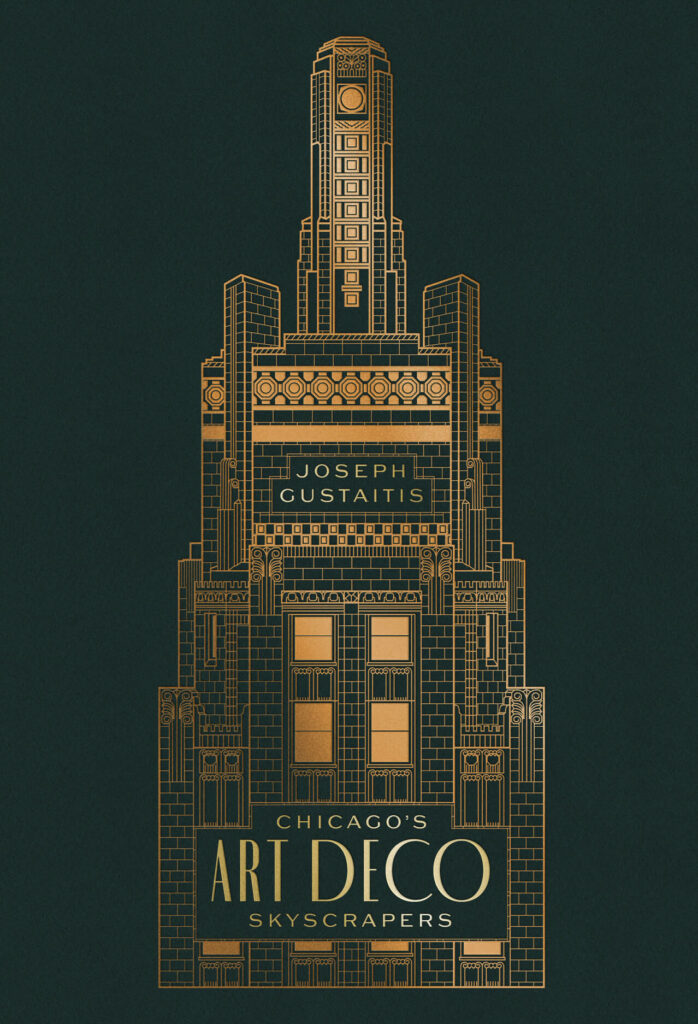 Chicago’s Art Deco Skyscrapers is a beautifully made, eloquently presented account of these artworks in the sky. Each skyscraper has its own chapter, detailing the exterior design of the structure as well as highlighting the Art Deco elements of the interior.
The richness of the Gustaitis’s research should delight architectural fans and experts, and, for the general reader, he tells a good story.
Indeed, making cameo appearances in the book are Sally Rand, the scandalous fan-dancer of the 1933 Chicago World’s Fair; Ray Kroc who made McDonald’s an international business behemoth; “Bathhouse” John Coughlin, one of the most infamous and corrupt of Chicago aldermen; Playboy, the nude-foldout magazine empire that once put its name on the Palmolive Building, and Joseph Kennedy, the founder of the family dynasty and owner of the Merchandise Mart for a time.
God’s-eye views
Yet, the Art Deco towers are the stars, and Chicago’s Art Deco Skyscrapers presents them in a way that they have rarely, if ever, been seen before—from above (apparently from the perspective of a drone), photographed with vibrant color and detail by Ian McClellan.
McClellan made such God’s-eye view images of eighteen of the towers, and they are startling and startlingly beautiful since almost no one ever sees them from this point of view. Most of us only see skyscrapers from the sidewalk, looking way, way up, or maybe in a truncated view from a nearby building.
However, McClellan could only offer photos from the ground up for two of the structures—Chicago Motor Club, now Hampton Inn North Loop, and the Buckingham Building—apparently because the from-the-clouds perspective wasn’t possible.
Two dominant architectural firms
The architectural firm responsible for the “catalog of Art Deco themes” at the Merchandise Mart was Graham, Anderson, Probst & White (GAPW).
By the time the Mart was completed in 1930, GAPW had already designed two other Art Deco towers: the Civic Opera House and the Foreman State National Bank Building, now called 33 North LaSalle, both in 1929. These they followed with the Central Post Office and the Field Building, now called 135 South LaSalle Street, both in 1934.
Yet, while GAPW accounted for a quarter of the 20 buildings in Gustaitis’s book, another firm was responsible for even more.
Holabird & Root designed six of the great towers: 333 North Michigan (1928), Chicago Motor Club (1929), Chicago Daily News Building, now 2 North Riverside Plaza (1929), the Palmolive Building (1929), the Chicago Board of Trade (1930) and Buckingham Building (1930). In addition, Holabird & Root worked with the firm of Rebori, Wentworth, Dewey & McCormick in developing plans for the LaSalle-Wacker Building (1930), although it was Andrew Nicholas Rebori of the second firm who is generally credited with the design.
Three of Art Deco skyscrapers are far distant from the Loop: Northwest Tower, now called the Robey (1929), at 2018 W. North Ave. in the Wicker Park neighborhood; the Powhattan Apartments (1929) at 4950 S. Chicago Beach Dr. in the Hyde Park community; and Mundelein Center (1930), originally Mundelein College, now part of Loyola University, at 6363 N. Sheridan Rd.
Rounding out the score of Art Deco gems are 10 W. Elm (1929), the Carbide and Carbon Building (1929), Trustees System Service Building, now called Century Tower (1930), One North LaSalle (1930) and Lawson House, formerly a YMCA (1931).
Warm sensual joy
These twenty towers express an exuberant spirit, a lively creativity and a warm, even sensual joy, but their moment was cut short by the dark days of the Depression.
After the Field Building, no other skyscrapers were built in Chicago for nearly a quarter of a century. And, by then, the fashion had shifted to the unadorned coldness of the glass-and-steel International Style, a striking contrast to the Art Deco towers.
If the International Style structures tended to look like sleek boxes, their Art Deco elders were happily indecorous in elegant, artistic ways. Sally Rand and Playboy, for instance, weren’t the only connections that the towers have had with nudity.
In the Tavern Club at 333 N. Michigan were murals by Chicago painter John Warner Norton, and Gustaitis writes:
One of the most famous (or notorious) panels was a leafy scene depicting what seemed to be a seated philosopher accompanied by an undressed nymph or sprite. Norton never gave it a name, but over the years “Pagan Paradise” caught on.
Two years after the tower opened, the Tavern Club put on a show at the Goodman Theatre including a live re-creation of the panel. “Yes, sir,” wrote a reporter, “we had a real nymph just the way she is in the painting without a stitch of clothes on…Her name was Trudye.”
Norton’s nymph has a sister of sorts over at the Chicago Board of Trade Building.
Most Chicagoans are familiar with the lady on the top of that structure, a well-draped 31-foot-tall sculpture of Ceres, the goddess of grain, who looks pretty small up there so high.
But, as Gustaitis details, there is another similarly 31-foot-tall female image inside the building, a looming mural by Norton of a bare-breasted Ceres. He includes one image of the Ceres on the roof and two of the interior mural.
Such fleshly art fits the high spirits of Chicago’s Art Deco towers which, a century after their construction, still fill the city’s skyline with beauty and buoyancy. And Chicago’s Art Deco Skyscrapers captures that rapturous, creative vitality with gusto and zest.
Chicago’s Art Deco Skyscrapers is available at bookstores and through the University of Chicago Press website.
Patrick T. Readon
11.7.26
This review originally appeared at Third Coast Review on xxx.xxx.xxxx.
Written by : Patrick T. Reardon

For more than three decades Patrick T. Reardon was an urban affairs writer, a feature writer, a columnist, and an editor for the Chicago Tribune. In 2000 he was one of a team of 50 staff members who won a Pulitzer Prize for explanatory reporting. Now a freelance writer and poet, he has contributed chapters to several books and is the author of Faith Stripped to Its Essence. His website is https://patricktreardon.com/.