
Near the end of Sandra Scoppettone’s 1991 mystery Everything You Have Is Mine, Lauren Laurano takes the half hour drive from New York City to Morristown, New Jersey.
Laurano, a private eye trying to track down a murderer, is in a down mood because returning to her home state brings back painful childhood memories. She’s also on her way to Craymoore, a mental institution, to dig up the records of a homeless woman she’s just met. She stops for coffee at a luncheonette.
The place is called M.J.’s. Inside it’s like almost any other luncheonette in America. A Formica counter with vinyl stools, booths, and a few freestanding tables. I take a spot at the counter.
When the counterwoman brings the coffee, Laurano asks her how to get to Craymoore.
The counterwoman’s directions are impeccable, and I pull into the Craymoore parking lot six minutes later.
Modern readers may find that interaction odd or quaint or confusing. Who asks for directions anymore? Just listen to the voice of GPS.
Also, who eats lunch at a luncheonette? The once ubiquitous diners are few and far between nowadays, elbowed out by competition on the low end by fast food restaurants and on the higher end by foodier joints.
The crimes and the setting
Scoppettone, who died October 29 at the age of 90, was a writer whose career extended for almost half a century from 1961 through the early 2000s. Among her nearly two dozen books were mysteries, young adult novels and two children’s books: Suzuki Beane (1961) and Bang, Bang, You’re Dead (1969), both with Louise Fitzhugh, later famous as the author of Harriet the Spy (1964).
Everything You Have Is Mine was the first of five mysteries centering around Laurano, a lesbian happily married (although, in those days, not officially) to Kip Adams, a psychotherapist. It was followed in 1993 by I’ll be Leaving You Always and then the three others, ending in 1998.
These Laurano novels work well as mysteries, but their setting — New York City and Laurano’s gay community — are just as important, if not more. Laurano, a former FBI agent, is a clever, dogged detective whose investigations take place amid the other aspects of her life and on the elegant and gritty streets of Manhattan.
“A gorgeous burgundy suede suit”
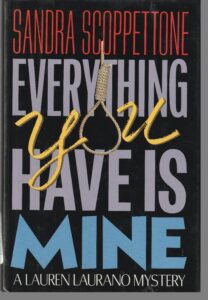 In Everything You Have Is Mine, she’s trying to catch a rapist and track down a murderer, maybe the same person, but she’s also delighting in chocolate desserts and attentive to how people dress, such as Kip at eight in the morning after Laurano has spent the night going down rabbit-holes in the internet.
She’s wearing a gorgeous burgundy suede suit, a light-gray silk blouse, and high dark-gray boots. Even through my bloodshot eyes I see that she looks smashing.
As for her friend, a straight, married cop named Peter Cecchi:
Cecchi’s a tad under six feet and extremely attractive. His abundant black hair’s shot full of gray, and his dark eyes look beautifully wounded, as though he’s seen more than any person should. A meticulous man, under his open black topcoat he wears a dark-blue suit, a light-blue shirt, and a silver-gray tie.
And, throughout the book, Laurano, the narrator, is providing a running commentary on the city, such as when she tracks down someone in Chinatown:
Chinatown is spreading like an oil spill. It’s moved north in the last few years, encroaching on Little Italy like a raider attempting a hostile takeover. At least, this is how the Italians view the situation.
A snapshot of the past
Scoppettone’s attention to such detail — outside the strict requirements of suspects and plots — give her Laurano novels the feel of a snapshot, the stopping of a moment in time.
In 1991, when her book was published, readers, especially those in big cities and those attentive of clothing fashions and chocolate desserts, would find much that resonated with their own lives. The same is true today, but not to the same extent.
In fact, part of the fun of reading Everything You Have Is Mine today is to notice how much American life has changed over the past thirty-five years, such as we no longer ask for directions and we’d have a harder time now finding a lunch counter.
Consider Washington Square Park:
Years ago the park was unsullied and innocent. People played guitars and sang; children cavorted while adults lay on the grass, sunning themselves. Now the park’s a haven for drug dealers and their customers. Everything changes.
And, since 1991, so has the park, now restored and cleaned up, no longer the magnet of junkies and their pushers.
“The names tumble round”
At that time, of course, the gay communities of New York and the rest of the nation were in the midst of the HIV pandemic which Laurano notes:
Although I’ve been no stranger to funerals these past few years, it doesn’t get easier. The names tumble round in my mind like laundry in a dryer. Jerry, Stephen, Gloria, Barry, Mitch, Danny, Tom, Larry Norma, John, Phil, Jane, Gwyda, Dino, and on and on.
As a reader who remembers those years and those many funerals, I couldn’t help but think that Scoppettone used these sentences to mention the names of people from her own life who had died from the virus. In 1991, it was often a death sentence. Today, it often can be managed.
On a lighter note, Laurano is given the laptop of a young murder victim and goes through humorous twists and turns trying to figure out how to use it and its modem — remember dial-up modems? — and then getting caught up in the endless temptations of the bulletin boards of the then-new World Wide Web.
For the reader of 2026, it’s funny when Laurano has to explain what email is and GIFs.
Too pretty
Also funny — in retrospect — are the ways men, in particular, act toward women in a condescending or flirty way that Laurano fights when she can and ignores when she has to.
For instance, she’s in a computer store, and the salesman is calling her honey and sweetie:
“I’m not your honey or your sweetie.” This is dumb to do right now, but my feminist side comes to the fore, unstoppable.
“What’re you,” he says, laughing, “a dyke?”
“Yes.”
“Huh?”
Later, he says he knows she’s not a lesbian because she’s too pretty.
“Weed them out early”
A conversation like that is a lot less likely today. So is one that Laurano has with the dean of Easton, an elite boys school, about a school ring worn by a rapist.
The dean says the rapist isn’t necessarily an Easton graduate since he could have gotten it another way.
“Like having an affair with one of the graduates,” I ask.
He gives a snort of contempt. “Hardly.”
“You mean, none of the boys from Easton is homosexual?”
“We weed them out early,” he answers with pride.
A lot has changed over the past three and a half decades, and a lot of it has been for the better.
Patrick T. Reardon
11.8.26
Written by : Patrick T. Reardon

For more than three decades Patrick T. Reardon was an urban affairs writer, a feature writer, a columnist, and an editor for the Chicago Tribune. In 2000 he was one of a team of 50 staff members who won a Pulitzer Prize for explanatory reporting. Now a freelance writer and poet, he has contributed chapters to several books and is the author of Faith Stripped to Its Essence. His website is https://patricktreardon.com/.