
Louise Fitzhugh was a subversive author of young adult novels. Which is to say that Fitzhugh used her quirky characters and plots to deal with issues that were hard to face head on or, because of parental judgement, weren’t allowed to be faced head on.
Her much-loved — by preteens and teens — 1964 novel Harriet the Spy has been banned by some schools and libraries because of claims that it sets a bad example and teaches children to lie and spy and talk back and act out.
But it’s a novel about a passion for knowing reality, a passion for truth. “I want to know everything, everything. Everything in the world, everything, everything.” — that’s what eleven-year-old Harriet says.
Nobody’s Family Is Going to Change, Fitzhugh’s 1974 novel, tells the story of an affluent New York City African American family whose eleven-year-old daughter wants to be a lawyer and her seven-year-old brother dreams of being a dancer. This was half a century ago when such ideas weren’t countenanced by many fathers and mothers.
She wrote two other Harriet-related books. Sport, published posthumously in 1979 — Fitzhugh died of a brain aneurysm at 46 in 1974 — focuses on one of Harriet’s friends, but she doesn’t appear in the story.
The other, a true sequel, was The Long Secret which is about a summer that Harriet, still eleven and bursting with brash curiosity, spends in Water Mill, Long Island with her quiet and shy twelve-year-old friend Beth Ellen Hanson.
“As though bitten by a snake”
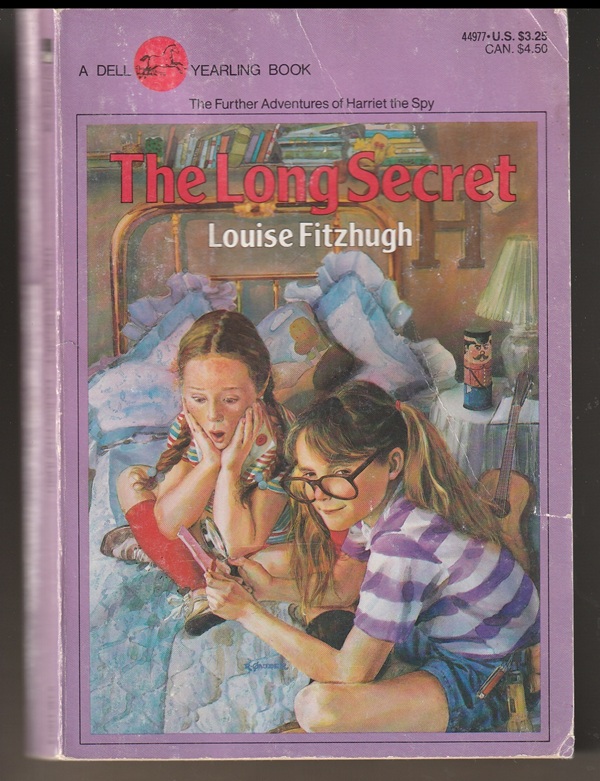 A measure of the subversiveness of this Fitzhugh novel is that, on the first page, a grumpy supermarket cashier suddenly shrieks “as though bitten by a snake” and holds up a large piece of paper with red crayon writing:
JESUS HATES YOU
What a message to include in a young adult novel! Talk about all but asking for a thundering damnation of the book by those who believe that Jesus loves you.
But Fitzhugh’s subversiveness gets even worse by going off in another direction.
Beth Ellen, Harriet and other characters in the story do something that almost no one outside of devotional Christian literature does — they talk about God and religion and belief.
Such topics of faith don’t usually appear in young adult novels because the secular world — which includes book publishers — is uncomfortable with spiritual stuff. That’s stuff that can’t be seen and touched so American society, both in the 1970s and today, goes about its daily business without reference to religious belief.
You’re more likely to find a novel for preteens and teens about vampires or extraterrestrials or terrorists or zombies or the shopping mall.
“Thinking about Catholics”
In the house where Beth Ellen lives with her Protestant grandmother is a small shrine to Mary, the mother of Jesus, installed with a Bible by previous owners who were Catholic. It was pretty, the grandmother said, so she kept it.
Beth Ellen sat thinking about Catholics. What did it feel like to be a Catholic? Did you feel more than other people? Maybe your head was filled with pretty things.
She walks over to look at the open page of the Bible.
Did her grandmother read the Bible?…Did the cook, the chauffeur, the maid?…She noticed the book was open to Psalms. She read a line: “O sing unto the Lord a new song.” I wish I had a new one to sing, she thought. She suddenly became intensely bored and wanted to close the book…The only person I like in the whole Bible is Jeremiah, she thought wearily.
“Do they really mean it?”
About halfway through the novel, Harriet asks her father if he’s religious, and he answers that he is even though not part of any organized faith. “I don’t know I could look at those stars and not be a religious man,” he says.
“Because…I just wondered about very religious people,” Harriet shifted around a bit. She wondered what it was she had wondered.
“What about them?”
“Well…I don’t know. I just wondered. Do they really mean it?”
“Some of them. Some of them don’t…I do think, though, that we should respect someone’s religion whether we share it or not…I mean, never laugh at anyone’s religion, because whether you take it seriously or not, they do.”
“Would He spy?”
Harriet asks her mother who says she does believe in God and does pray. And Harriet remembers going to church once with her former nurse Ole Golly who “had said that she should at least see what it was like. It had made her itch.”
She and her mother talk about God a bit and then it’s time for a snack before bed, and Harriet thinks to herself:
I don’t know if I want there to be a God. Wouldn’t He spy on me all the time and know everything I thought? Where is He, anyway?
One of Beth Ellen and Harriet’s friends Jessie Mae has gone so far as to create her own church in a forest clearing. It’s not a building or anything, but a circle of dirt that the light hits like the light in cathedrals.
“Y’all come on in,” she said sweetly. “This here’s my church.”
“Tired of waiting”
An adult whom the youngsters befriend is The Preacher, a Black man who explains to them his own doubts about faith, even though the poor, like him, find comfort in the hope that belief provides.
“But…,” Beth Ellen found herself talking without every planning to. “The meek shall inherit…like you said.” She suddenly heard her own voice and fell into anguished silence….
“You can tell them that for only so long,” said The Preacher quietly. “There comes a time when they’re tired of waiting.”
These religious meditations and discussions are only part of Louise Fitzhugh’s The Long Secret.
The novel has other more usual young-adult themes, such as Beth Ellen trying to cope with her ditzy mother and learning how to overcome her shyness.
Those themes are dealt with subversively, too.
But, for my money, Fitzhugh’s courage to tackle the questions and feelings and thoughts about God and faith is what makes The Long Secret such a good book.
Patrick T. Reardon
11.14.26
Written by : Patrick T. Reardon

For more than three decades Patrick T. Reardon was an urban affairs writer, a feature writer, a columnist, and an editor for the Chicago Tribune. In 2000 he was one of a team of 50 staff members who won a Pulitzer Prize for explanatory reporting. Now a freelance writer and poet, he has contributed chapters to several books and is the author of Faith Stripped to Its Essence. His website is https://patricktreardon.com/.